Grand Theft Auto IV — The American Dream, Delivered Damaged
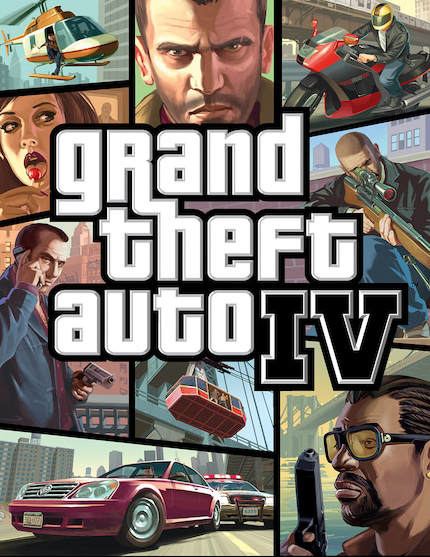
Niko Bellic crossed the Atlantic on a cargo ship called the Platypus, chasing a cousin’s letters that turned out to be fiction.
Grand Theft Auto IV, released worldwide for PlayStation 3 and Xbox 360 on 29 April 2008, is the series’ first modern reboot. New engine, new continuity, new Liberty City. It is also the entry that decided a joke could wait until after a funeral. Players who wanted Vice City’s grin found a war veteran who does not grin on command. Players who wanted a city that felt inhabited found one.
This is an independent long read. Sales records and the drunk-driving controversy are documented. Claims that IV is “the serious GTA” or that its endings make one path canon are fan arguments, and they stay labeled.
Launch: a hundred-million-dollar city
Preliminary work started in November 2004, a month after San Andreas. Rockstar North’s core team of about 220 people pulled in other Rockstar studios; the full effort involved more than a thousand people, including part-time and external staff. Leslie Benzies later estimated the budget at more than US$100 million, which put IV among the most expensive games ever made at the time.
Microsoft’s Peter Moore announced the game at E3 2006 by rolling up a sleeve to show a temporary tattoo of the logo. An October 2007 date did not hold. In August 2007 Take-Two slipped the game into fiscal Q2 2008, citing PlayStation 3 technical work. On 24 January 2008 Rockstar locked 29 April. Development stopped when the game went gold on 21 April.
Windows, ported with Rockstar Toronto, arrived 2 December 2008 in North America and 3 December in Europe after a further slip from November. Microsoft paid a reported US$50 million for two Xbox 360 episodic packs: The Lost and Damned (17 February 2009) and The Ballad of Gay Tony (29 October 2009). Both later landed on PlayStation 3 and Windows as Episodes from Liberty City on 13 April 2010 in North America and 16 April in Europe. The Complete Edition bundled everything on 26 October 2010 in North America and 29 October in Europe. The Xbox 360 version became Xbox One backward compatible on 9 February 2017. Capcom published the Japanese release on 30 October 2008.
Online multiplayer supported 16 players on consoles and 32 on Windows until Rockstar discontinued the PC service in 2020.
Liberty City, rebuilt as a character
This Liberty City is not III’s. Rockstar treats IV as the start of the “HD Universe,” a separate continuity from the PS2 trilogy. Broker stands in for Brooklyn, Dukes for Queens, Bohan for the Bronx, Algonquin for Manhattan. Across the water, Alderney is New Jersey. Bridges stay locked early, officially because of a terrorist threat; the police chase you if you force them. The lock is a design gate wearing a headline.
The team did not reuse old Liberty City maps. They photographed New York — Benzies claimed more than 100,000 shots; Garbut guessed around 250,000 — and shot hours of video that played on office televisions. Police officers drove them through Washington Heights. Dan Houser called the city “the biggest character” in the game. The map is smaller than San Andreas and, the developers argued, comparable in scope because of verticality and the decision to kill empty desert. They wanted “a more focused experience.”
Hove Beach, Niko’s first neighborhood, is Brighton Beach with a joke name. Sam Houser liked that the real neighborhood was full of Eastern Europeans. That is research, not a stereotype invented in a writers’ room without a passport.
Niko, who is tired on purpose
Michael Hollick voices Niko Bellic. Dan Houser and Rupert Humphries wrote a script of about a thousand pages. Roughly 660 actors recorded some 80,000 lines. Unlike earlier games, the writers said they were not chasing a specific film. Houser wanted the next stage of the series to stop being “a loving tribute.” Facial animation had improved enough that cutscenes could go slow.
Niko is an Eastern European ex-soldier. The game is careful not to pin a single real country to him in marketing, even as the world around him is loudly Slavic. He comes to America to leave a war, to get rich, and to find the man who sold his unit into an ambush ten years earlier. His cousin Roman (Jason Zumwalt) has been writing about mansions and women. Roman has a filthy apartment, a failing taxi company, and loan sharks.
Dan Houser called Niko “more of an anti hero than a hero, capable of making positive actions within his criminal world.” The dual register — he will save a stranger and take a contract — is the design brief. The team wanted an immigrant lead after talking to people who work around organized crime; Houser said “the real scary characters are not born in America anymore.” That is a writer’s claim from 2008. Treat it as the studio’s rationale, not sociology.
The story, including the fork
Niko works Roman’s mess. He befriends Little Jacob. He kills Vlad Glebov, the Russian who was sleeping with Roman’s girlfriend Mallorie. Mikhail Faustin and his lieutenant Dimitri Rascalov kidnap the cousins, then hire Niko anyway. Faustin orders a hit on Kenny Petrović’s son. Dimitri talks Niko into killing Faustin to settle Petrović. Then Dimitri walks Niko into Ray Bulgarin, who accuses Niko of stealing from an old human-trafficking job. Niko denies it. The room becomes a gunfight. Dimitri and Bulgarin leave. Roman’s apartment and depot burn.
In Bohan, Niko works for local dealers. Dimitri kidnaps Roman and fails to bait a trap. Michelle, Niko’s romantic interest, is an undercover agent; her boss — a government man who never quite becomes a person — drafts Niko to kill suspected terrorists in exchange for a cleaned record and help finding the traitor. Insurance money from the fire lets Roman rebuild and buy an Algonquin apartment. He proposes to Mallorie.
The Irish jobs introduce Patrick “Packie” McReary. The bank robbery with the McReary brothers is the set piece people still project on walls. Ray Boccino of the Pegorino family puts Niko on a diamond deal that collapses. Boccino’s payment is a lead: Florian Cravic, now Bernie Crane, was not the traitor. The man is Darko Brevic. Niko keeps working up the Pegorino chain. Don Jimmy Pegorino has him kill Boccino on a snitch rumor. A kidnapping of Giovanni Ancelotti’s daughter, meant to ransom the diamonds, is intercepted by Bulgarin; the stones vanish in the fight.
Government agents find Darko in Romania and deliver him. The player decides whether Niko kills him. That choice is moral coloring. The ending choice is structural.
Pegorino’s last favor is a heroin deal with Dimitri, who is waiting on the Platypus — the same class of ship that brought Niko here. Two official endings:
If Niko takes the deal, Dimitri betrays him again, kills Pegorino, and sends a hitman to Roman’s wedding. The bullet kills Roman. Niko hunts Dimitri.
If Niko takes revenge, he kills Dimitri. Pegorino hits the wedding and kills Kate McReary, whom Niko has been seeing. Niko hunts Pegorino.
In both versions Mallorie is pregnant, and Niko stays. The game does not bless a canon. Folklore picked favorites immediately. Officially, both endings are the game.
The Lost and Damned and The Ballad of Gay Tony run beside this plot, not after it. Johnny Klebitz and Luis Lopez walk through some of the same diamonds, the same wedding weather, from other rooms. That interlocking is the episodes’ reason to exist.
Set pieces and the new gunfight
The bank robbery is the one that entered the culture: masks, vault, street, the feeling that Liberty City’s grid is finally being used as a getaway. The diamond deal’s chaos is the comic counterpart. The wedding, in either ending, is the cruelty the story promised from the first lying letter.
Mechanically, IV is a cover shooter that learned from the generation around it. You stick to walls, blind-fire, aim at limbs. Health regenerates if you eat or call a medic. A phone — not a pager — holds contacts, cheats, and multiplayer. Friends have respect meters; hang out, and Roman will send a free cab. Internet cafés open email and dating. A subway actually crosses the city. Bowling and darts exist so the world has evenings, not just missions.
NaturalMotion’s Euphoria makes bodies fall like bodies. That was a talking point in 2008 and is still the first thing a new player notices when a pedestrian hits a hood. Rockstar also used Image Metrics for faces and SpeedTree for the trees. The targeting system was a first-principles rewrite; the cover system, Benzies said, was a “natural addition.”
Role-playing leftovers from San Andreas — gyms, weight, the need to eat as a stat — were dropped early. They did not fit a man who is not in America to improve his squat.
Radio for a city that is already loud
Music supervisor Ivan Pavlovich said the job was to pick songs that made New York sound like itself without dating the game before it shipped. Rockstar cleared more than 2,000 people for recording and publishing rights; Billboard reported fees as high as US$5,000 per composition and another US$5,000 per master. They hired a private investigator to find relatives of a dead Skatt Bros. member so they could license “Walk the Night.”
Liberty Rock Radio, hosted by Iggy Pop, is the classic-rock station. The Beat 102.7 is contemporary hip-hop; DJ Green Lantern produced exclusive material. Vladivostok FM is the Eastern European station that follows Niko into the car. Integrity 2.0, hosted by Lazlow, unlocks with Algonquin and is the talk show that knows it is in a GTA game. WKTT, Massive B Soundsystem 96.9, Tuff Gong, The Vibe, Electro-Choc, and the rest fill the rest of a very specific 2008.
An in-game record shop and an MP3 player for Niko were considered and cut. The radio remains the portable city.
The first trailer used Philip Glass’s “Pruit Igoe.” When Rockstar’s site buckled under traffic, people reposted fakes; some of those fakes were Rick Astley’s “Never Gonna Give You Up.” The Rickrolling meme’s early public chapter is, officially, a GTA IV trailer pile-up.
Aftermath: records, moral panics, a long shadow
IV sold more than 3.6 million copies in twenty-four hours, about US$310 million, and more than US$500 million in a week — then the fastest-selling entertainment product on record. A month later it had sold over 8.5 million. Guinness logged highest grossing game in 24 hours, highest revenue for an entertainment product in 24 hours, and fastest-selling game in 24 hours. Take-Two put lifetime sales over 20 million by March 2011 and over 25 million by July 2013. V later broke every one of those records.
Critics were close to unanimous. Metacritic still lists it among the highest-rated PlayStation 3 and Xbox 360 games. It won Game of the Year at the Spike VGAs, plus Best Action Adventure and Best Male Performance for Hollick. The New York Times, Time, and others put it on year-end lists.
Mothers Against Drunk Driving asked the ESRB to move the rating to Adults Only over the drunk-driving mechanic. Rockstar said the audience could handle the content. Jack Thompson tried to block the sale before launch; Take-Two sued him first; both sides dropped claims in a 2007 settlement. After release, a Bangkok taxi murder and a New York robbery were linked by police statements to the game; Thailand banned it. Those incidents are news items. They are not a design document.
PC multiplayer went dark in 2020. The Complete Edition is how most people replay it now. A 2007 Xbox 360 beta disc surfaced in 2026 from an Edinburgh car-boot sale and was posted online; that is a preservation story, not a patch.
Why IV still matters with VI on the calendar
IV taught Rockstar that a smaller map can feel larger if every block has a job. It taught them branching endings, friend schedules, and the cost of making a city the lead. V kept the HD continuity and threw out the single sad man. VI, officially, is another couple in another state, still in this universe’s weather.
Folklore says IV is the one Rockstar will not remaster because it is too sad, or too ugly, or too legally tangled. What is official is simpler: planned remasters of IV and Red Dead Redemption were reported as paused after the 2021 trilogy backlash, and no IV remaster has been announced.
Niko wanted the life in Roman’s emails. The game’s joke, if it has one, is that the emails were a kind of radio: a voice selling a city that does not exist. Liberty City exists. The dream does not. That is the whole review, and it is also the plot.
GTA6 NOW is an independent fan site and is not affiliated with Rockstar Games or Take-Two Interactive.
Also in this series: GTA VI · GTA V · San Andreas · Vice City · GTA Games
 What GTA 6 Fans Are Talking About Before November 19
 Tribunal filing: Rockstar treated a 32-player online format as a secret
 IGN's GTA 6 theft tape: cloners, search cones, and the two-second grab is gone
 Console shortages will not pull GTA 6 onto PC with the consoles
 Glasgow filings describe a 32-player GTA 6 Online session