Grand Theft Auto: San Andreas — Homecoming With a Body Count
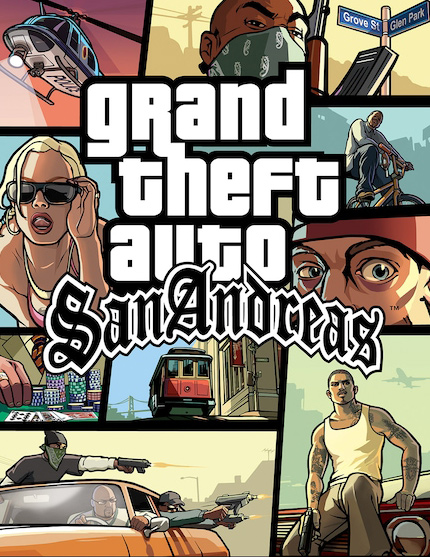
Carl Johnson came home for a funeral and found a city that had already written him out of the will.
Grand Theft Auto: San Andreas is the 2004 game people mean when they say a Grand Theft Auto can be a place instead of a street grid. Three cities, countryside, desert, a radio that changes the weather of a car ride, a lead who can gain weight and lose respect in the same afternoon. It is also a story about a man the police decide to own on the drive from the airport.
This retrospective is independent. Official dates, sales, and the Hot Coffee re-rating are documented. Fan readings — that CJ is Tupac, that the game is a 1992 documentary — are labeled as such.
Launch: a two-year build, a one-week explosion
Rockstar announced San Andreas in March 2004 after Take-Two had already registered the trademark. The first screenshots and a Game Informer cover landed at E3 in May. Two trailers followed in August and September. The North American PlayStation 2 date slipped from 19 October to 26 October; Europe slipped from 22 October to 29 October. Windows and Xbox versions were promised for early 2005 and arrived on 7 June in North America and 10 June in Europe.
The 75-person Rockstar North team — grown from the Vice City core after Manhunt shipped — spent nearly two years on the game, with a budget Rockstar has put under US$10 million. Producer Leslie Benzies said he hoped it would “revolutionize open-ended gameplay and video game production values.” Some staff later described the period as a “constant crunch,” with seventeen-hour days. That labor history is part of the record, not a footnote.
Later ports stacked up across Mac (2010), mobile (2013–2014), Xbox 360 (26 October 2014), PlayStation 3 (1 December 2015), and PlayStation 4 (5 December 2015). The Definitive Edition remaster arrived 11 November 2021. A promised Meta Quest VR port was listed as “on hold indefinitely” in August 2024.
A special edition on 8 October 2005 bundled the in-engine short The Introduction — a 21-minute prequel film — and Rockstar’s documentary Sunday Driver.
A state, not a skyline
San Andreas is California and Nevada compressed into one map: Los Santos for Los Angeles, San Fierro for San Francisco, Las Venturas for Las Vegas, with countryside and desert between them. The team originally pictured three separate maps linked by transit. They built one map instead. Aaron Garbut put the world at about 36 square kilometres — four to six times III or Vice City — with each city roughly Vice City’s size.
The year is 1992. That is official, and it is doing narrative work. The writers drew on the Bloods and Crips rivalry, the crack years, the 1992 Los Angeles riots, and the Rampart scandal inside the LAPD. They hired Los Angeles natives DJ Pooh, Estevan Oriol, and Mister Cartoon. They photographed the real cities. Compton informed Los Santos’s neighborhoods; the Golden Gate Bridge informed Gant Bridge. Climate is color-coded: Los Santos red-orange, San Fierro blue, Las Venturas red.
Dan Houser said the team watched “hundreds of movies to get the California vibe.” Boyz n the Hood, Colors, and Menace II Society are the named narrative references. The countryside was compared internally to Deliverance, San Fierro to Bullitt, Las Venturas to Casino. Those are studio analogies, not a claim that any mission is those films.
Sam Houser told Electronic Gaming Monthly that after East Coast III and 1980s Miami, “going to L.A. in the early ’90s just seemed like an obvious place for us to go.”
CJ, and the voice they didn’t already know
Young Maylay, then an unknown, voices Carl “CJ” Johnson. Sam Houser did not want another recognizable movie star in the lead after Ray Liotta; he wanted CJ to feel “very, very human.” Rockstar overheard Maylay talking with DJ Pooh and asked him to audition. It was his first acting role. He has said the team let him put his own personality into the character. DJ Pooh compared CJ’s mix of family loyalty and coldness to Tupac Shakur. That comparison is a collaborator’s, not a studio press line, and it should stay in that box.
CJ left Los Santos for Liberty City five years earlier. He comes back because his mother is dead — a drive-by. At the airport he is intercepted by Community Resources Against Street Hoodlums officers led by Frank Tenpenny, voiced by Samuel L. Jackson. They threaten to pin a cop killing on him unless he cooperates. The game’s first lesson is institutional: the gang is not the only organization that can ruin your week.
The story, without the wiki bullets
Grove Street has fallen apart. Sweet, CJ’s brother (Faizon Love), is trying to hold a splintered Grove Street Families together. Kendl, their sister (Yo-Yo), is with Cesar Vialpando (Clifton Collins Jr.) of Varrios Los Aztecas. Big Smoke (Clifton Powell) and Ryder (MC Eiht) talk like the old days. They are not.
CJ does the neighborhood work. He pulls sets back together. He helps neighbor OG Loc (Jonathan Anderson) start a rap career by stealing Madd Dogg’s rhyme book and killing the rapper’s manager — a subplot that later curdles into guilt when Madd Dogg, voiced by Ice-T, tries to jump from a building. CJ saves him, eventually becomes his manager, and takes the mansion back from dealers. The game is willing to let CJ be both the problem and the cleanup.
The betrayal is visual. CJ and Cesar watch Big Smoke and Ryder meet Tenpenny and the Ballas. They killed Beverly Johnson. CJ runs to a Ballas shootout to save Sweet; Sweet is wounded and jailed. Tenpenny dumps CJ in the countryside and uses Sweet’s safety as a leash. The middle of San Andreas is exile as a map.
In the countryside CJ meets The Truth (Peter Fonda), an aging hippie grower, and later Wu Zi Mu (James Yaegashi), the blind Triad leader everyone calls Woozie. Street races win CJ a San Fierro garage. He turns it into a chop shop with Kendl and Cesar. The Loco Syndicate — Smoke and Ryder’s drug pipeline — is based there. CJ works his way inside and meets Mike Toreno (James Woods), who seems like the boss and is, in fact, a government agent who refuses to stay dead.
CJ, Cesar, and the Triads destroy the factory and the leadership, including Ryder. Toreno survives and starts calling. The jobs are black-budget nonsense; the payment is Sweet’s release. In Las Venturas, Woozie opens a casino and the pair rob a Mafia competitor, Caligula’s Palace. The heist is the series practicing for later, bigger scores.
Sweet gets out. The Families take territory back. Tenpenny is arrested, then walked because there are no witnesses left who will talk. Los Santos riots. CJ finds Smoke in a fortress of money and product. Smoke dies admitting he wanted the power. Tenpenny steals the cash, triggers an explosion, and flees in a fire truck. The chase ends when he loses control and crashes off a bridge overlooking Grove Street. CJ and the remaining family watch him die. The riot ends. At the Johnson house, people celebrate. CJ steps outside to check the block.
That last gesture is the game: you can win the state and still have a street to worry about.
Set pieces that escaped the game
The train chase — officially the mission “Wrong Side of the Tracks” — became infamous for its difficulty. Big Smoke’s line on failure, “All we had to do, was follow the damn train, CJ!”, is now a series catchphrase. Grand Theft Auto V later nodded at it. That is documented culture, not a claim that the mission was designed as a meme.
Big Smoke’s fast-food order became a 2016 meme. CJ’s early line, “Ah shit, here we go again,” exploded in April 2019. Players have dropped CJ into Dark Souls, Breath of the Wild, Street Fighter 6. None of that is official content. It is what a character does when he is drawn clearly enough to survive being pasted into other worlds.
The Caligula’s robbery, the desert work for Toreno, the riot, and the fire-truck chase are the story’s own set pieces. The gang-territory wars — attack a block, survive three waves, then defend it forever — are the mechanical ones people still argue about. They turn the map into a chore and a pride project at the same time.
Radio as a living weather system
San Andreas rebuilt how GTA radio works. Stations no longer loop a fixed medley. Songs shuffle. Weather forecasts are accurate to the game world. News updates can reflect story progress. Eleven stations, twenty DJs — Axl Rose, Chuck D, and George Clinton among them — and more than three times the licensed music of III. Michael Hunter wrote the main theme, partly from childhood Yo! MTV Raps memories.
Interscope released a two-disc compilation in November 2004 and an eight-disc box set in December. Windows, Xbox, and later mobile versions added a custom station for the player’s own files.
Radio Los Santos, Playback FM, K-DST, K-Rose, Radio X, and WCTR are the stations most people can still name in a car. The point is not the list. The point is that a drive from Los Santos to Las Venturas can change genre the way the landscape changes color.
What the machine could do now
Swimming. Dual-wielding. Aircraft and remote-control vehicles in a roster of more than 180. Hydraulics, nitrous, stereo upgrades. Gyms that teach boxing, kickboxing, and mixed martial arts. A body that responds to food and exercise: muscle helps in a fight; neglect shows. Clothing, hair, tattoos. Respect that friends actually track. Skills for driving, guns, lung capacity, stamina. Dating. A two-player split-screen roam. Stealth borrowed from Manhunt. Casinos that are real minigames because the scripting tools had caught up.
RenderWare’s pipeline was rewritten for more polygons on screen, real-time reflections, volumetric lighting, and separate day/night lighting. Buildings shared low-detail stand-ins so the huge map could stream without Vice City’s hard loads. The countryside driving took a cue from Rockstar’s own Smuggler’s Run.
It is the most systems-heavy mainline GTA. Some of those systems — the gym grind, the weight, the girlfriend meters — were stripped out of IV because they fought the new lead’s tone. That does not make them a mistake. It makes them specific to this game’s idea of a life.
Aftermath: records, Hot Coffee, and a remaster that wasn’t
San Andreas sold 4.5 million copies in its first week, 45 percent more than Vice City. In the United States it moved 2.06 million in six days and took US$235 million in week one. The UK sold an estimated 677,000 copies and about £24 million in a weekend. It was 2004’s best-selling game: 5.1 million in the US, more than 1.75 million in the UK. By 2009 the PlayStation 2 version alone had sold 17.33 million, the platform’s best seller. Worldwide figures reached 21.5 million by April 2008 and 27.5 million by 2011.
Critics gave it “universal acclaim.” It won Game of the Year, Best Action Game, Best Soundtrack, and Best Performance by a Human Male (Jackson) at the Spike Video Game Awards. The Golden Joysticks named it Ultimate Game of the Year and split Hero and Villain between CJ and Tenpenny.
Then Hot Coffee. The team had cut an animated sex minigame to keep an ESRB Mature rating but left the data in the files. After the Windows release, modder Patrick Wildenborg enabled it. The ESRB moved the game to Adults Only. Australia banned it until the content was removed. The Federal Trade Commission warned Rockstar and Take-Two. A class action followed. The ESRB created fines of up to US$1 million for undisclosed content. The official story is not “there was a sex scandal.” The official story is that hidden code became a ratings crisis and a policy change.
The 2021 Definitive Edition landed about as poorly as Vice City’s. Original digital listings vanished, then returned. The afterlife already had the memes and the mods.
Toward a different Los Santos, and then the water
When Rockstar built Grand Theft Auto V, Dan Houser said putting three cities in San Andreas had limited how well they could emulate Los Angeles. Garbut said technical limits made the 2004 Los Santos feel like “a backdrop or a game level with pedestrians randomly milling about,” and that V’s city started from that admission. IV had already chosen density over acreage.
San Andreas remains the series’ widest breath. VI is not a sequel to it. VI is a return to Vice City’s climate with V’s production scale. If you want to understand why Rockstar now treats a single state as a decade of work, start with the game that tried to do California and Nevada in two years and almost got away with it.
GTA6 NOW is an independent fan site and is not affiliated with Rockstar Games or Take-Two Interactive.
Also in this series: GTA VI · GTA V · GTA IV · Vice City · GTA Games
 What GTA 6 Fans Are Talking About Before November 19
 Tribunal filing: Rockstar treated a 32-player online format as a secret
 IGN's GTA 6 theft tape: cloners, search cones, and the two-second grab is gone
 Console shortages will not pull GTA 6 onto PC with the consoles
 Glasgow filings describe a 32-player GTA 6 Online session